
Family: Apiaceae (Carrot family)
Synonyms: Chaerophyllum pecten-veneris ,Myrrhis pecten-veneris ,Selinum pecten-veneris ,Wylia pecten-veneris,
Common name: Shepherd’s needle, Venus’ comb, Storks needle, Cheedhi kanga , Lady’s comb.
Local Name: Jangli Saunf, Ban Saunf (जंगली सौंफ).
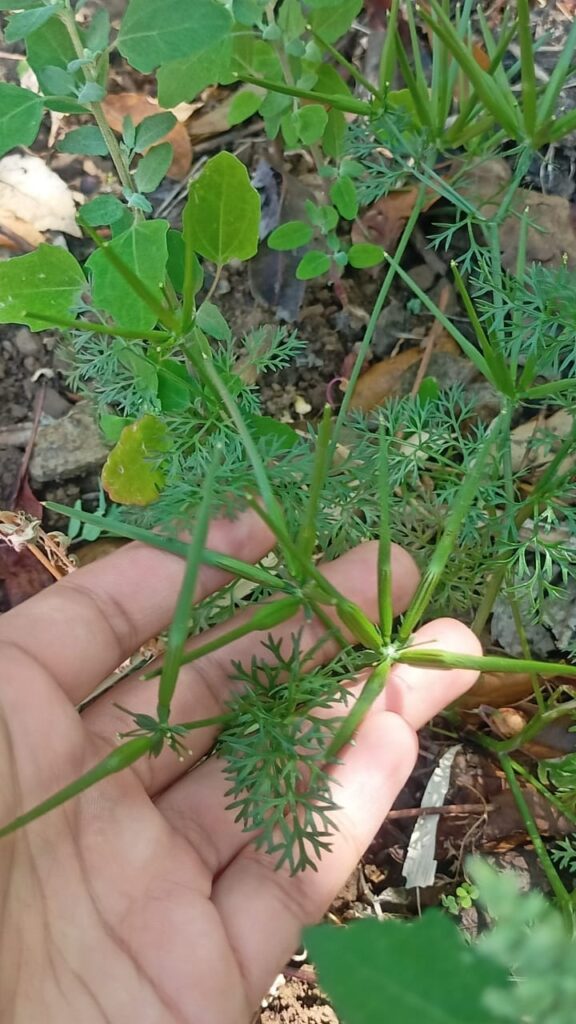
Jangli Saunf, is a delicate, erect annual herb, typically 15–45 cm in height. Belonging to the carrot family and exhibits finely divided, feathery leaves with slender stems Jangli Saunf, holds a humble yet fascinating place. In India, especially in the north-western Himalayan foothills. “Owing to its resemblance to fennel in both appearance and mild aroma, it is locally referred to as ‘Jangli Saunf’ or ‘Ban Saunf’. Jangli Saunf is well-known for its distinctive needle-like fruits, which give rise to the name “Shepherd’s-needle.” This herb grows wild during spring in cultivated fields, field margins, and open grassy slopes, easily grown from seeds thrives particularly in loamy soils and is often found as a winter-season weed in wheat and barley fields, especially in temperate to sub-temperate climates between an altitude of 800-1800

Jangli Saunf prefers full sun and moist but well-drained soil. Though considered a weed by many modern farmers, this plant was once well recognized for its culinary and medicinal properties. The tender shoots and leaves are occasionally used as a potherb in rural areas, either cooked exclusively or mixed with other available greens. Its light fennel-like aroma adds a subtle flavour to dishes1. The herb was also once included in traditional spring green mixes, much like Chenopodium or Fumaria. As modern agricultural practices have led to the decline of many seasonal wild herbs, Jangli Saunf is becoming increasingly rare in some areas. Raising awareness of its benefits and incorporating it into seasonal wild herb collections could not only revive its use but also strengthen the bond between traditional knowledge and sustainable living. In folk medicine, Jangli Saunf” is valued for its digestive and carminativeproperties. The seeds, like other members of the Apiaceae family, are mildly aromatic and were traditionally chewed to ease stomach discomfort. A decoction of the plant has been used for its diuretic and cleansing effects, especially during seasonal transitions. Despite its reputation as a weed, Jangli Saunf is considered a bio-indicator of fertile and moist soils. Its presence in fields often points to good organic content in the soil. In regenerative agriculture, such species are being reconsidered as indicators of soil health and potential biodiversity boosters. Jangli Saunf is harvested from natural habitat as a source of food, fodder and medicine for local personal uses. It can be cultivated directly by sowing seeds in early spring after the last frost.
Encouraging its recognition, cultivation and usage could contribute to the revival of culinary diversity and natural health practices.
Jangli Saunf Plant:
Erect, annual herbs, 15-50 cm high, usually branching a little above the base.
Branches glabrous.
Leaves 5-20 cm long, pinnately decompound into fine segments; segments narrow, linear, acute, slightly hairy on the margins.
Umbels simple or compound; peduncles elongating to 2-5 cm in fruit. Involucre bract 1, linear or none. Rays 1-3. Involucel of several bracts, lanceolate, oval or ovate, ciliate.
Flowers white, 3-4 mm across.
Fruits 2.5-4.5 cm long, clavate, bluntly vertically ridged, hispid at least along the margins above; beak twice as long as the seed.

Jangli Saunf can be harvested in different stages for varied uses. The young aerial parts are best collected from late winter to early spring, when the plant is tender and suitable for culinary use. It enters the flowering and fruiting stage from March to April, with its aromatic seeds maturing by late spring to early summer. These edible seeds can be used as a spice or for medicinal purposes. Since seeds are the primary means of propagation, it is important to ensure sustainable harvesting—either by practicing habitat rotation or by leaving a portion of the seeds on the parent plant to allow natural regeneration.
Edible Uses:
Jangli Saunf is an edible plant. Its tender leaves, young stems, and fruits are all used in cooking. The leaves are often eaten raw in salads, boiled and tossed with a little oil, or added to pies. The young stems and shoot terminals can also be enjoyed raw or cooked, making it a versatile and tasty addition along with leaves to dishes like chilla, omelette, soup, tea, stir-fry and leafy vegetable saag along with other greens in following manner.
Jangli Saunf Soup
Ingredients:
Jangli Saunf leaves, 1 cup (washed and chopped); Onion, 1 small (chopped); Garlic cloves, 2 (minced); Carrot, 1 small (diced); Tomato, 1 (chopped); Cumin seeds, 1/2 teaspoon; Black pepper, a pinch; Salt, to taste; Olive oil or ghee, 1 tablespoon; Water, 3 cups; Fresh coriander leaves, 1 tablespoon (chopped, for garnish)
Method:
Heat olive oil or ghee in a pot and add cumin seeds. Once they splutter, add chopped onion and garlic, and sauté until softened. Add diced carrot and chopped tomato, and cook for another 3–4 minutes. Add the chopped Jangli Saunfleaves and stir. Pour in 3 cups of water, add salt and black pepper, and bring the soup to a boil. Reduce the heat and let it simmer for 10–15 minutes, allowing the flavors to meld together. Once done, blend the soup if you prefer a smooth texture, or leave it chunky for a rustic feel. Garnish with chopped coriander leaves and serve hot.

Jangli Saunf Bhaji (Wild Fennel Stir-fry)
Ingredients:
Jangli Saunf leaves, 1 cup (chopped and tender); Onion, 1 small (finely chopped); Garlic cloves, 1–2 (finely chopped); Green chili, 1 (optional, finely chopped); Mustard oil or ghee, 1 tablespoon; Cumin seeds, 1/4 teaspoon; Turmeric powder, 1 pinch (optional); Salt, to taste; Lemon juice, 1 dash (optional)
Method:
Heat mustard oil or ghee in a pan and let it smoke lightly if using mustard oil. Add cumin seeds and let them splutter. Then add finely chopped garlic cloves and green chili, sauté for a few seconds. Add finely chopped onion and cook until translucent. Add a pinch of turmeric powder if using. Stir in chopped Jangli Saunf leaves, mix well, and cook on low heat for 5–7 minutes, stirring occasionally until the leaves wilt and release their aroma. Add salt to taste. Finish with a dash of lemon juice if desired and serve hot with roti or rice.
Jangli Saunf Omelette
Ingredients:
Eggs, 2; Jangli Saunf leaves, 1/2 cup (washed and finely chopped); Onion, 1 small (finely chopped); Green chili, 1 (finely chopped, optional); Fresh coriander leaves, 1 tablespoon (chopped, optional); Milk, 2 tablespoons (optional, for a softer omelette); Salt, to taste; Black pepper, a pinch; Oil or butter, 1 tablespoon.
Method:
Crack the eggs into a bowl. Add Jangli Saunf leaves, onion, green chili, coriander leaves, salt, black pepper, and milk if using. Beat well to combine everything. Heat oil or butter in a non-stick pan over medium heat. Pour the mixture into the pan and spread it evenly. Cook until the base sets, then carefully flip and cook the other side until golden and cooked through. Serve hot with roti, paratha, or bread.
Jangli Saunf Chilla
Ingredients:
Jangli Saunf leaves, 1/2 cup (washed and finely chopped); Gram flour (besan), 1 cup; Onion, 1 small (finely chopped); Green chili, 1 (finely chopped, optional); Ginger, 1 teaspoon (grated); Fresh coriander leaves, 1 tablespoon (chopped, optional); Turmeric powder, 1/4 teaspoon; Cumin powder, 1/2 teaspoon; Red chili powder, 1/4 teaspoon (optional); Salt, to taste; Water, as needed; Oil, for cooking
Method:
In a mixing bowl, combine gram flour, chopped Jangli Saunf leaves, onion, green chili, grated ginger, coriander leaves, turmeric, cumin powder, red chili powder (if using), and salt. Add water gradually to form a smooth, pancake-like batter. Heat a non-stick pan and lightly grease it with oil. Pour a ladleful of batter onto the pan and spread it into a round shape. Cook on medium heat for 2-3 minutes until the bottom is golden, then flip and cook the other side until crisp and golden brown. Serve hot with chutney or yogurt.
Jangli Saunf herbal tonic Tea
Ingredients:
Jangli Saunf leaves & fruits, 1 tablespoon (fresh, washed, and chopped); Water, 1 cup; Fresh ginger, 1 teaspoon (grated); Lemon juice, 1 teaspoon (optional); Honey, 1 teaspoon (optional); Black pepper, a pinch (optional)
Method:
In a small pot, bring 1 cup of water to a boil. Add the chopped Jangli Saunf and grated ginger. Let it simmer for 5–7 minutes to extract the flavors. Strain the tea into a cup, discarding the leaves and ginger. If you like, add a pinch of black pepper for an extra kick. Sweeten with honey and add lemon juice to taste. Stir well and enjoy this refreshing and healthy tonic tea, perfect for digestion and boosting immunity.
Nutritional value:
The nutritional composition of Jangli Saunf reveals its potential as a valuable wild food plant. It contains 81.31% moisture, 3.82% crude protein, 7.32% total carbohydrates, 3.10% ash, 0.63% total lipids, and provides an energy value of 50.23 Kcal per 100 grams. The plant also contains 0.76% total sugars, including 0.64% reducing sugars and 0.12% non-reducing sugars, along with 0.11% pectin. Its lipid content includes 0.43% saponifiable lipids and 0.20% non-saponifiable lipids2 .
Mineral analysis shows that Jangli Saunf is rich in essential elements Na, 381 mg; K, 2206 mg; Mg, 370 mg; Ca, 3200 mg; Fe, 200 mg; Cu, 54 mg; Zn, 16 mg; Mn, 9 mg; Cr, 0.40 mg; Ni, 2.40 mg, and P, 518 mg per 100 grams3. The fatty acid profile indicates that it contains 31.83% total saturated fats, 12.02% total monounsaturated fats, and 31.29% total polyunsaturated fats3.
Seek Professional Advice before treating this plant medicinally.
Medicinal use:
Traditionally, Jangli Saunf has been utilized in folk medicine across the Western Himalayas for a range of conditions, including ulcers, infections, mouth and throat irritations, body pains, toothaches, digestive disorders, and skin ailments. The young leaves have been consumed as a mild digestive aid, believed to stimulate appetite and alleviate minor gastrointestinal discomfort 4. In some traditions, the plant has been valued for its diuretic properties, helping to promote the elimination of excess fluids and support kidney function5. Topical applications of crushed leaves have been used to reduce minor inflammations and relieve joint pains, while infusions prepared from the aerial parts were employed to soothe coughs and throat irritations6. The young shoots were traditionally consumed in spring as a general tonic to replenish vital nutrients after the harsh winter months 7.
Recent studies have highlighted additional medicinal potentials of Jangli Saunf, including its ability to reduce chronic inflammatory diseases, aid in blood coagulation, and alleviate toothaches. The plant is also commonly prepared as a tea, and research has demonstrated its ability to decrease tumor necrosis factor-alpha (TNF-α) levels and inhibit nitric oxide synthesis 8,9. Furthermore, the root of Jangli Saunf contains a bitter principle that imparts antiphlogistic, astringent, and eupeptic properties. This has supported its traditional use in treating dyspepsia, gastroenteritis, cystitis, nephritis, and pyelitis. Additionally, the plant exhibits notable antioxidant properties10, further contributing to its therapeutic significance.
Spiritual Use:
Jangli Saunf is a plant with a long and interesting history. Although it is not very common in modern spiritual practices, it still carries a lot of old meanings and traditions. In the past, people connected Jangli Saunf to harvest, fertility, and protection. The plant gets its name because its fruit has fine, comb-like bristles, which reminded people of ancient harvest goddesses, especially in old cultures. It was often linked to the idea of the “last sheaf” — the final bundle of grain gathered at harvest time, which was seen as very special and sometimes magical.
In some old folk beliefs, Jangli Saunf was also connected to wise old women or healers, sometimes called “Old Wives” or “Witches.” These women were respected for their knowledge of plants and healing. This connection likely comes from traditions where women played important roles in harvest and healing ceremonies.
Because of its strong ties to harvest and growth, Jangli Saunf became a symbol of fertility (the ability to grow new life) and protection. Today, while it’s not a major part of big religions, some people still use it in small personal rituals or magical practices — for example, to bring good luck, encourage fertility, or create a feeling of safety.
References:
- Aglaia, L.T. (2014). Wild food plants of India.
- Imran, M., Khan, M.A., & Hussain, J. (2007). Nutritional evaluation of some selected wild edible plants of Pakistan. Pakistan Journal of Botany, 39(3), 659–665.
- Zeghichi S, Kallithrka S, Simopoulos AP, Kypriotakis Z (2003) Nutritional composition of selected wild plants in the diet of Crete. In: Simopoulos A, Gopalan C (eds) Plants in human health and nutrition policy. World Rev Nutr Diet. 91:22-40
- Facciola, S. (1990). Cornucopia: A Source Book of Edible Plants. Kampong Publications, Vista, California.
- Grieve, M. (1931). A Modern Herbal. London: Jonathan Cape.
- Duke, J. A. (2002). Handbook of Medicinal Herbs (2nd ed.). CRC Press, Boca Raton, Florida.
- Chevallier, A. (1996). The Encyclopedia of Medicinal Plants: A Practical Reference Guide to over 550 Key Herbs and Their Medicinal Uses. Dorling Kindersley, London.
- Alli, L. A., Adesokan, A. A., Salawu, O. A., Akanji, M. A., & Tijani, A. Y. (2011). Anti-inflammatory and analgesic activities of the leaf extracts of Scandix pecten-veneris L. (Umbelliferae). Journal of Medicinal Plants Research, 5(18), 4442–4446.
- Amin, M. J., Ahmad, A., & Beg, A. Z. (2013). Antimicrobial and antioxidant activities of Scandix pecten-veneris extracts. Asian Journal of Pharmaceutical and Clinical Research, 6(3), 121–124.
- Ayoola, G. A., Coker, H. A. B., Adesegun, S. A., Adepoju-Bello, A. A., Obaweya, K., Ezennia, E. C., & Atangbayila, T. O. (2008). Phytochemical screening and antioxidant activities of some selected medicinal plants used for malaria therapy in Southwestern Nigeria. Tropical Journal of Pharmaceutical Research, 7(3), 1019–1024.
Hello, i feel that i noticed you visited my web site so i got here to “return the desire”.I am trying to find issues to enhance my web site!I guess its ok to make use of some of your concepts!!
Wow that was unusual. I just wrote an very long comment but after I clicked submit my comment didn’t appear. Grrrr… well I’m not writing all that over again. Anyhow, just wanted to say superb blog!
Today, I went to the beachfront with my children. I found a sea shell and gave it to my 4 year old daughter and said “You can hear the ocean if you put this to your ear.” She put the shell to her ear and screamed. There was a hermit crab inside and it pinched her ear. She never wants to go back! LoL I know this is totally off topic but I had to tell someone!
I’ve been absent for some time, but now I remember why I used to love this blog. Thanks, I will try and check back more often. How frequently you update your web site?
Fantastic site you have here but I was curious about if you knew of any user discussion forums that cover the same topics talked about here? I’d really love to be a part of online community where I can get feed-back from other knowledgeable individuals that share the same interest. If you have any recommendations, please let me know. Many thanks!
Thank you for your sharing. I am worried that I lack creative ideas. It is your article that makes me full of hope. Thank you. But, I have a question, can you help me?
I like the helpful information you provide in your articles. I will bookmark your weblog and check again here frequently. I’m quite sure I?ll learn plenty of new stuff right here! Best of luck for the next!
Very nice post. I simply stumbled upon your blog and wished to say that I’ve really loved browsing your blog posts. In any case I’ll be subscribing on your rss feed and I hope you write again soon!
Undeniably imagine that that you said. Your favourite justification seemed to be at the net the simplest thing to be mindful of. I say to you, I definitely get irked even as other folks consider worries that they plainly don’t understand about. You controlled to hit the nail upon the top as neatly as outlined out the whole thing without having side-effects , other people could take a signal. Will probably be back to get more. Thank you
Great remarkable things here. I am very satisfied to peer your post. Thank you so much and i am taking a look ahead to touch you. Will you please drop me a e-mail?
hi!,I love your writing so a lot! share we be in contact extra approximately your post on AOL? I require an expert on this house to solve my problem. May be that is you! Taking a look forward to peer you.
Great, I should certainly pronounce, impressed with your site. I had no trouble navigating through all tabs as well as related information ended up being truly simple to do to access. I recently found what I hoped for before you know it at all. Reasonably unusual. Is likely to appreciate it for those who add forums or something, site theme . a tones way for your client to communicate. Excellent task.
Awesome blog! Do you have any recommendations for aspiring writers? I’m hoping to start my own site soon but I’m a little lost on everything. Would you propose starting with a free platform like WordPress or go for a paid option? There are so many options out there that I’m completely confused .. Any tips? Kudos!
Simply want to say your article is as surprising. The clarity in your put up is just nice and i can think you’re an expert in this subject. Well together with your permission allow me to clutch your RSS feed to stay up to date with coming near near post. Thanks 1,000,000 and please continue the rewarding work.
Fantastic items from you, man. I have take note your stuff previous to and you’re just too wonderful. I actually like what you’ve acquired here, certainly like what you are saying and the way in which by which you say it. You’re making it enjoyable and you still take care of to stay it sensible. I can not wait to learn much more from you. This is really a wonderful website.